What brand architecture actually is, explained through record collecting, crisp brands and vacuum cleaners.

Brand architecture
What belongs together, what stands apart, and why it matters more than most businesses think.
What is brand architecture?
Brand architecture links your business strategy to the communication your audience actually sees. It sets out how every part of a business, products, services, divisions, sub-brands, relates to everything else, so customers know instantly what belongs together and what doesn't.
Done well, it does three things. It organises the basic relationship between everything in a portfolio. It rationalises the offer so there's less to work through, and it's easier for customers to find what they need. And it clarifies everything through names, labels and messages that are consistent and mean something.
There are four common approaches. Monolithic, everything the same, one brand leading everywhere, think FedEx or Apple. Endorsed, stick it on anything, sub-brands with their own personality borrowing trust from a parent, think Virgin Atlantic or Virgin Money. Branded, own it all, each product standing entirely on its own, think Dove or Persil under Unilever. And Hybrid, a bit of everything, usually what large organisations end up with as they grow, think Google sitting under Alphabet, or YouTube sitting apart from both.
Most businesses should start simple. Monolithic is the default for good reason, it's easier to manage, cheaper to run, and clearer for the people you're trying to reach. Complexity should be earned, not assumed.
Monolithic, endorsed, branded and hybrid, the four shapes a brand portfolio can take.
The theory holds up in the boardroom. It holds up just as well on a record shelf, a crisp aisle, and the side of a vacuum cleaner, which is where it gets easier to see.
Define a brand: record collecting
Before architecture, a brand needs defining. The clearest way through it is three questions, based on the Simon Sinek method: what, how, and why.
Take a record collection. The what is the offer, the products and services on the table. In this case, a genuinely large one: 3,176 seven-inch singles, 920 twelve-inch singles, and 1,649 LPs.
The how is the differentiation, the unique approach that makes it different from anyone else's shelf. Here, that's personal curation, records bought and chosen since the age of ten, not assembled to impress anyone.
The why is the purpose, the difference it makes, the big vision behind it. For a record collection, that's the emotional connection of listening, now and in the future, the reason any of it was worth keeping in the first place.
Same three questions work for any business. What you sell, how you're different doing it, and why any of it matters. Skip straight to architecture without answering these first, and the structure has nothing solid to hang off.
What, how, why, the same three questions that define a business apply just as cleanly to a wall of records.
Brand architecture: crisp eating
Once a brand's defined, architecture is the decision about how everything beneath it relates. A supermarket crisp aisle shows all three main models at once, on the same shelf.
Monolithic, Walkers' own core range: Ready Salted, Cheese & Onion, Prawn Cocktail, Smoky Bacon, all one brand, one identity, different flavours of the same thing. The strength is visibility, consistency, and ease of management. The weakness is that it's genuinely difficult to differentiate one product from another when they all look and feel the same.
Endorsed, Walkers' wider snack range: Doritos, Monster Munch, Quavers, French Fries, each with its own personality, each still carrying a Walkers or PepsiCo mark somewhere on pack. The strength is flexibility, the parent brand enhances what sits beneath it without controlling every detail. The weakness is potential conflict between the core brand and the sub-brand's own character, and it costs more to maintain than one identity would.
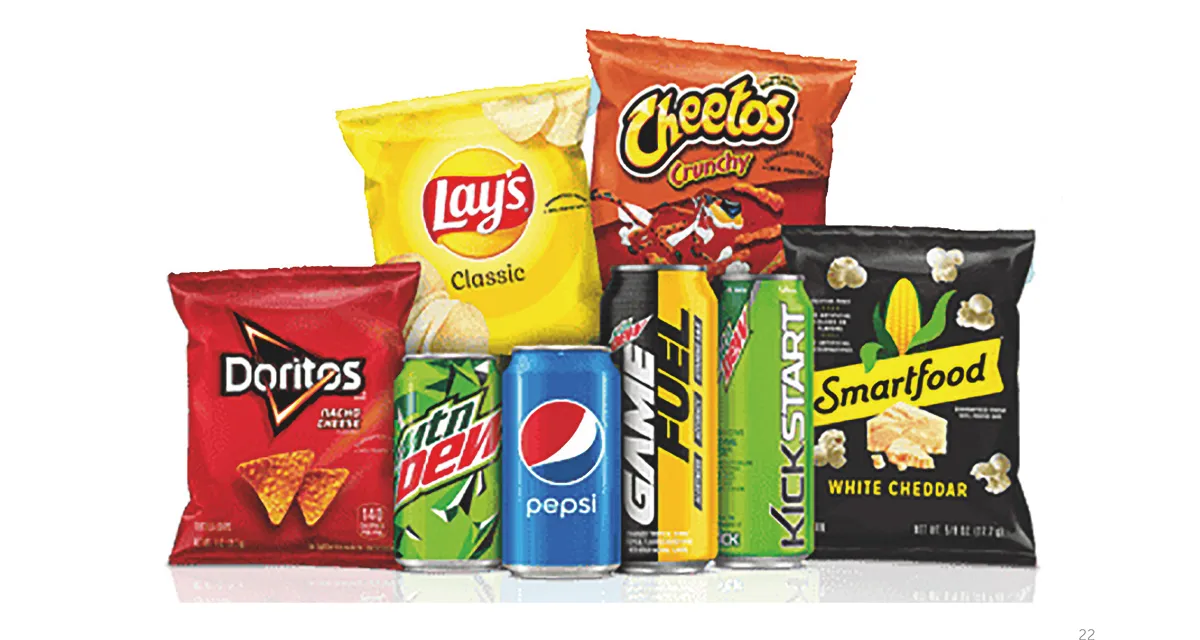
Branded, PepsiCo's wider ownership: Lay's, Cheetos, Doritos, Pepsi, Smartfood, each a fully independent brand competing on its own terms, with no obvious shared parent visible on shelf. The strength is that every brand can have its own personality and compete freely. The weakness is that the parent brand becomes low-key and diluted, and it's expensive to promote and maintain that many separate identities well.
None of the three is right or wrong. Which one fits depends entirely on the audience and the offer, not on what feels more impressive to build.
Same shelf, three different architectures, monolithic, endorsed and branded, all doing their job at once.
Record collecting and crisp eating cover definition and structure. The third piece, naming, is where a lot of brands quietly fall apart.
Product naming: vacuum cleaning
Naming should create clarity, not decoration. Every name in a portfolio is really doing four jobs at once: the parent brand, the product name, the unique benefit, and the category. Three vacuum cleaners show how differently that can play out.
Dyson names by parent and product first: Dyson DC39 Animal Plus Vacuum Cleaner. The parent brand carries the trust, the product name and benefit do the differentiating.
Numatic does the opposite. Henry, the smiling red cylinder, barely mentions Numatic at all. Henry Plus Vacuum Cleaner leads entirely with product personality, the parent brand is almost invisible, and that's a deliberate choice, not an oversight.
Hoover sits in between. Hoover Helix Pets Bagless Vacuum Cleaner, owned by Techtronic Industries, a parent brand most customers have never heard of and don't need to. Hoover itself does the trust-building work.
The question worth asking of any name isn't whether it sounds good. It's which of those four jobs, parent, product, benefit, category, actually needs to show up for that audience, and which can stay quiet.
Parent brand, product name, unique benefit, category, the same four-part naming logic behind Dyson, Henry and Hoover.
Key takeaway
Brand architecture is mostly invisible when it's working. Customers shouldn't need to study the structure to understand a business, whether that's a record collection, a crisp aisle, or a vacuum cleaner range. Define the brand first, choose the simplest structure that still creates clarity, and name things so the right thing stands out for the right reason. Complexity should always be earned, never assumed.
Next Step
If you are ready to explore your own brand more deeply, begin with The Brand Check a simple free tool that helps you see where your brand is strong and where it needs focus.
Or continue reading the Untangle Your Brand Vault for more short lessons and ideas to help you build a brand that is relevant, unique, and memorable.
The tips and decision guide walks through the same models in worksheet form, with the full sheet to download.